- AEO
- AI Search
Answer Engine Optimization (AEO): The Complete Guide
Updated
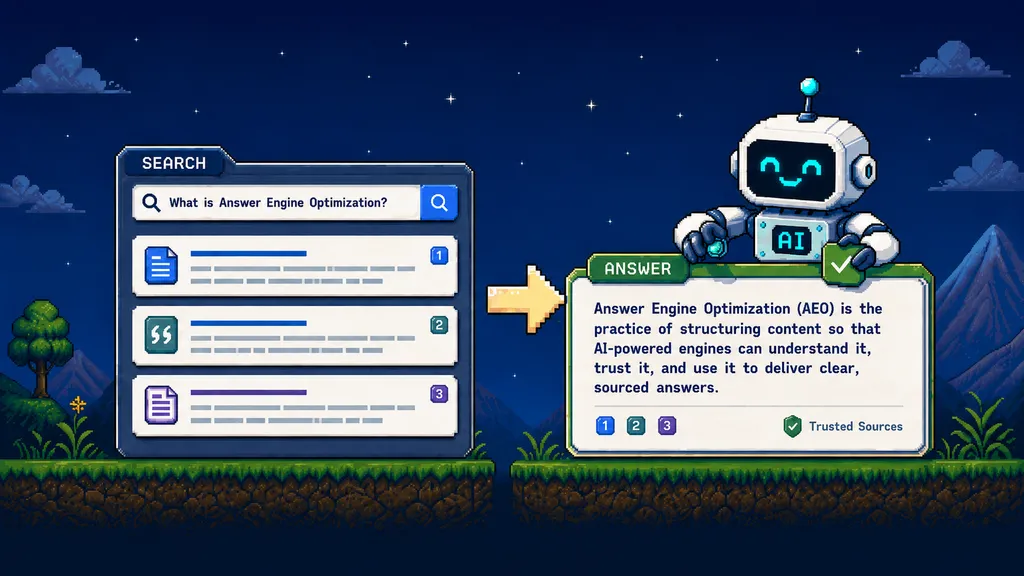
Answer Engine Optimization (AEO) is the practice of improving your content and technical signals so a site can be discovered, understood, and considered as a source in AI-powered search experiences like ChatGPT, Perplexity, and Google’s AI Overviews. It builds on traditional SEO rather than replacing it. If your site isn’t crawlable and indexed, you’re not even in the candidate pool. The work of AEO is improving your odds of being used once you are.
That’s the whole discipline in two sentences. The rest of this guide is the part that actually takes years to learn. It walks through how these systems tend to choose what to quote, what the data says about where the clicks went, and what to do about it, in priority order, with the myths clearly labeled as myths.
If you already know SEO, you’re closer than you think. This guide maps every AEO concept back to the SEO concept it descends from, so you can skip the hype and get to the work.
10 blue links · you pick
- bigagency.com › blog › seo-audit-timelineHow Long Does an SEO Audit Take? [2026 Guide]A technical SEO audit usually takes anywhere from one to four weeks depending on site size and scope…
- toolvendor.com › seo-auditFree SEO Audit Tool: Instant ReportRun an automated audit in seconds. Sign up for the full crawl and prioritized fixes…
- forum.example.com › r/SEO › audit-timeHow long did your last audit actually take?Honestly mine took like 3 weeks for a 5k page site, most of that was waiting on dev access…
One synthesized answer · citations chosen for you
A technical SEO audit typically takes two to three weeks for most sites under 10,000 pages. That's roughly a week of crawling and data collection, a week of analysis, and a few days to produce a prioritized fix list. Larger or more complex sites can run longer.
Sources1 · auditlog.example2 · bigagency.com3 · forum.example.com
Notice the source that got quoted first isn't the biggest domain. It's the one with the cleanest, most specific answer paragraph. That's the whole game.
What is AEO, exactly?
Answer engine optimization (AEO) is the practice of improving content and technical signals so a site can be discovered, understood, and considered as a source in AI-powered search experiences like ChatGPT, Perplexity, Google’s AI Overviews, and Microsoft Copilot. It’s how you compete when the search result is a paragraph instead of a list of links.
An “answer engine” is any system that synthesizes a direct answer from multiple sources. ChatGPT alone passed 900 million weekly users in February 2026. When one of these platforms answers a question, it retrieves passages from a handful of pages, blends them into a response, and cites the sources it leaned on. AEO is the work of improving your odds of being one of those sources.
Here’s a simplified mental model to start with: traditional search mostly ranks documents, while answer engines tend to quote passages from them. It’s an analogy, not literal architecture. AI search systems still rank and select among sources, and traditional search has extracted passages (featured snippets) for years. The useful takeaway is where the emphasis shifts.
A ranking is a popularity contest between pages. A citation is closer to an editorial decision about a passage, a specific paragraph, list, or table the model judged safe to lift. That emphasis drives most of the tactics in this guide. A beautifully written 2,000-word essay that buries its conclusion in paragraph twelve gives the model nothing easy to quote. A mediocre page with one crisp, self-contained answer paragraph often does better. I’ve watched it happen in both directions, and it’s humbling.
Does any of this actually matter yet?
Yes, and the data points one direction. The clicks are leaving, citations are becoming the scarce asset, and the visitors who still click are worth more than they used to be. Every number below is dated and attributed, with links to primary sources wherever they exist, because a guide about earning citations should probably behave like something worth citing.
Searches increasingly end without a click. In the first four months of 2026, 68% of US Google searches ended without a click, up from 60.4% in 2024. That’s the steepest two-year jump SparkToro has measured since it started tracking. AI answers are the qualitatively new ingredient. They synthesize the information, which removes the reason to click at all.
AI Overviews suppress the clicks that remain. Pew Research tracked 900 US adults across 68,879 real Google searches. When an AI summary appeared, users clicked a traditional result on 8% of searches, versus 15% without one. Links inside the AI summary got clicked 1% of the time.
Ahrefs measured the same effect from the other side. Across 300,000 keywords, the presence of an AI Overview cut the top result’s clickthrough rate by 34.5% in April 2025, and when the same team re-ran the analysis on December 2025 data, the reduction had grown to 58%.
And AI Overviews keep spreading. How often depends on whose tracker you trust and which queries they sample. Semrush’s 10-million-keyword panel put prevalence between roughly 16% and 25% of queries through 2025, while BrightEdge found AI Overviews on 89% of healthcare keywords by December 2025. The studies disagree because their keyword mixes differ, branded vs. non-branded, informational vs. transactional. The direction is not in dispute.
Now the part the doom headlines skip.
The clicks that survive are better clicks. Semrush’s June 2025 analysis found AI search visitors convert at roughly 4.4 times the rate of traditional organic visitors. The AI did the comparison shopping before the click, so the person arriving has already decided you’re worth a visit. And being cited pays even when the click doesn’t happen immediately. Seer Interactive’s study of 25 million impressions found brands cited in AI Overviews earned 35% higher organic CTR and 91% higher paid CTR on those same queries compared to uncited brands.
Keep the volume in perspective. AI platforms still drive only 0.15% to 0.25% of global web traffic per Similarweb, though that share grew roughly 790% in 2025.
And remember Gartner’s famous February 2024 prediction that search volume would drop 25% by 2026? It didn’t happen. Google adapted, kept its market share, and search volume held. The lesson isn’t “ignore the forecasts.” It’s that the volume didn’t leave. The clicks did. People still search constantly. What changed is how often anyone visits the sources.
AEO vs. SEO: how is AEO actually different?
AEO is not a replacement for SEO. It’s a layer on top of it. Most AEO work is SEO work, things like crawlability, indexation, matching search intent, and building genuine authority. What changes is the unit of competition, which shifts from the page to the passage, and the goal, which shifts from the click to the citation.
The under-appreciated fact about AEO is that AI platforms lean on conventional search and their own crawlers to find candidate sources. Google’s AI Overviews draw from Google’s index. ChatGPT Search uses OpenAI’s own search crawler, OAI-SearchBot, to discover and surface sites. If you’re not crawlable, fast, and indexed by the systems you want to appear in, no amount of clever answer formatting will save you, because you were never in the room where the answer got assembled.
If you already know SEO, this translation table is the fastest way in.
| You already know (SEO) | The AEO equivalent | What actually changes |
|---|---|---|
| Keyword research | Question and prompt research | Queries become conversational, so you target the questions behind the keywords |
| Ranking #1 | Being cited in the answer | Only 38% of AI Overview citations now come from top-10 pages, down from 76% in mid-2025 |
| Link building | Corroboration and brand mentions | Branded web mentions are Ahrefs’ #1 predictor of AI Overview citation, stronger than links |
| Featured snippet optimization | Passage extractability | Same skill, much bigger surface. A featured snippet is an extracted answer |
| Title tag CTR optimization | Quotability of your first two sentences | The “reader” deciding whether to use you is a model, not a human scanning titles |
| Rank tracking | Citation share-of-voice sampling | Same prompt, different answer each run, so you sample repeatedly instead of checking a position |
The shift from link building toward brand mentions is one of the bigger strategic changes in that table. For two decades, the dominant currency of authority was the hyperlink. Several citation studies now find that being talked about, across news, reviews, YouTube, and communities, correlates with AI visibility at least as strongly as being linked to. Treat it as link building growing up rather than links no longer mattering: authority, relevance, rankings, and web presence still do the heavy lifting, and mentions are an additional signal, not a replacement.
The relationship between the disciplines runs both ways, which is why the investment is safe even if you’re AI-skeptical. A featured snippet is just an extracted answer with a 2019 haircut, so the same structure that makes a page quotable for AI also tends to win the snippet in regular search. One piece of work, two payoffs.
Does it matter whether you call it AEO, GEO, or something else?
Not really. These are four names for one discipline. GEO (generative engine optimization) came out of a Princeton research paper (Aggarwal et al., KDD 2024) and won the enterprise and agency crowd. AEO dominates beginner-facing content from Semrush and HubSpot. LLMO (large language model optimization) had a moment with technical audiences and is fading. And Ahrefs and Google both essentially argue it’s all just SEO, since Google’s own guidance for appearing in AI features is, almost verbatim, its standard SEO guidance.
Where people do bother distinguishing them, GEO is the umbrella for visibility in generative engines generally, and AEO is the sharp end, being the extracted answer to a specific question. In practice the terms are interchangeable, and no consensus definition separates them.
My take is simple. Call it whatever gets the budget approved, because the work converges no matter the label. I say AEO because the people I work with ask questions, they don’t submit “generative queries.”
How do answer engines actually work?
Answer engines generally work in a few moves. They retrieve passages from a search index, often expand one question into several related sub-queries, favor passage-level information over whole pages, and match on both keywords and meaning. Most AEO tactics that work, and most failures that look mysterious from the outside, follow from those moves. This is a useful cartoon of the pipeline, not a universal architecture every platform implements the same way. (These are search-and-synthesis systems rather than systems that act on a site. How AI agents differ from answer engines covers that distinction, though the two increasingly overlap.)
Retrieval, then generation
When you ask ChatGPT or Perplexity a question that needs current information, the model doesn’t answer from memory. It runs a search, retrieves relevant passages from the index, and then generates an answer grounded in what it retrieved. The industry calls this RAG, short for retrieval-augmented generation. The implication is blunt. If your content isn’t retrievable and digestible at that middle step, you don’t exist at answer time. You’re not penalized or demoted, you’re simply absent from the answer.
Query fan-out
Some AI search experiences use query fan-out, or related-query expansion, to investigate several aspects of a question before assembling an answer. Rather than retrieving only for your exact words, the system may break the question into related sub-queries. “Best time to replace my roof” can branch into “signs you need a new roof,” “roof replacement cost factors,” “best season for roof installation,” and “how long does roof replacement take,” each quietly filling in variables the person implied but never typed, like budget, timeframe, region, and skill level. The diagram below is a conceptual example. The exact behavior varies by platform.
Then the engine retrieves for each branch and assembles the answer from the best passages across them. This is one reason your content can be surfaced for a query it doesn’t rank for, because it only needs to be useful for one branch. It’s also why thin content struggles so quietly: a page that answers the literal keyword but none of the related questions is competing on a single branch. The Ahrefs citation data is consistent with this, since nearly a third of AI Overview citations now come from pages ranking beyond position 100 for the visible query. Those pages are winning the sub-queries you can’t see.
One question becomes a dozen
Pick a query, or type your own, and watch it expand the way an answer engine does before it retrieves anything. Each chip is a sub-query you could win independently.
- signssigns you need a new roof
- costhow much does a roof replacement cost
- timingbest season for roof installation
- timinghow long does a roof replacement take
- comparemetal vs asphalt shingle roof
- howtohow to choose a roofing contractor
- otherroof warranty considerations
- definition
- cost
- compare
- timing
- howto
- signs
- other
Passage-level structure matters
AI-powered search systems can retrieve and use passage-level information, which makes clear section structure and direct answers valuable. That doesn’t mean every paragraph is independently scored, or that you should artificially break a page into isolated chunks. The practical implication is narrower: important answer passages should carry enough context to remain understandable when excerpted. A passage that begins “As mentioned above, this approach also…” loses its meaning when lifted out. One that begins “Metal roofs last 40 to 70 years with proper maintenance” can be quoted into almost any answer.
Words and meaning
Retrieval can consider both the words you use and the meaning behind the query. Classic keyword matching still applies, and modern systems also match on meaning, finding passages that are conceptually close to a question even when the exact words differ. Traditional SEO hygiene keeps you competitive on the words. Self-contained, entity-rich, plainly worded passages help on meaning. This is one reason natural topic coverage matters alongside conventional keyword targeting, and the tidiest rebuttal to “SEO is dead” and “AEO is nothing new” at the same time.
When good content gets skipped, the cause is usually structural, not topical. Here’s the checklist I run against every page before it goes live.
- Extractability. Can a passage stand on its own?
- Evidence density. Does every sentence carry verifiable information?
- Scope clarity. Are the conditions stated, like dates, regions, or versions?
- Authority. Does the platform know who is making the claim?
- Freshness. Is there a visible date, and is it recent?
A perfectly accurate page still gets skipped when the structure is wrong.
Where does each platform get its answers?
The platforms are architecturally different, and the differences are practical, not trivia. Ahrefs found only about 11% of domains get cited by both ChatGPT and Perplexity, so a single strategy won’t blanket every surface.
| Platform | What site owners should know |
|---|---|
| Google AI Overviews / AI Mode | Visibility is rooted in Google Search indexing and its ranking and quality systems. No separate AI markup is required |
| ChatGPT Search | OpenAI documents OAI-SearchBot for search discovery and separate user-triggered access through ChatGPT-User. Keep the site accessible to the systems you intend to allow |
| Perplexity | Perplexity documents PerplexityBot for search discovery and Perplexity-User for user-triggered requests, and fetches live pages at answer time, so speed and server-rendered HTML matter |
| Microsoft Copilot | Scope any statement to current Microsoft documentation rather than assuming Copilot sourcing is identical to Bing web results |
Two practical things follow from all of this.
The first is that AI providers use different systems for different purposes. A provider may operate separate systems for training, for search and discovery, and for user-triggered retrieval. Blocking one does not automatically have the same effect as blocking another.
In your server logs these look almost identical. They are visiting for three different reasons, and blocking each one costs you something different.
- TrainingGPTBot · ClaudeBot · Google-ExtendedModel trainingContent may help build a future model
If you block itA content-use decision. Little effect on whether you appear in AI search.
- Search & discoveryOAI-SearchBot · PerplexityBotThe search indexWhat answer engines retrieve from
If you block itYou can disappear from that platform’s answers entirely.
- User-triggeredChatGPT-User · Perplexity-UserOne person’s questionFetched live, because someone asked
If you block itAffects pages a person specifically asked for. Usually not governed by robots.txt.
For AEO, the important point is simple:
- A training-crawler decision is primarily a content-use choice.
- Blocking a documented search/discovery crawler can affect whether your pages are available as sources in that provider’s search experience. OpenAI documents that sites opted out of OAI-SearchBot won’t be shown in ChatGPT search answers, and Perplexity recommends allowing PerplexityBot to appear in its results.
- User-triggered retrieval is a separate behavior again.
Don’t treat every “AI bot” as one category. For the provider-by-provider breakdown, robots.txt controls, browser-agent traffic, and verification, use the companion guide: Is Your Website Ready for AI Agents?
The second is to use Perplexity as your test kitchen. It shows its citations transparently and fetches live, which makes it a fast feedback loop in AI search. Change a page, ask the question again, and see whether your citation appears. What you learn there ports reasonably well to the platforms that hide their work.
What actually gets cited?
The strongest verified predictors of AI citations are branded web mentions, third-party corroboration, and passage-level structure, not rankings and not backlinks. This industry has produced a lot of confident advice and much less evidence, so here’s what the data actually supports, with the myths flagged right after.
Rankings still matter, but much less than they did. Ahrefs’ 863,000-keyword study found only 38% of AI Overview citations come from top-10 pages, down from 76% in mid-2025. The rest split almost evenly between positions 11-100 and beyond 100. Those are fan-out wins, invisible to a rank tracker.
Brand mentions show a strong correlation with AI visibility in some studies. Branded web mentions correlated with AI Overview citations at 0.664, the strongest signal Ahrefs tested. Correlation isn’t causation, and one study doesn’t establish a universal ranking factor, so read it as a pointer, not a formula. Conventional authority, relevance, rankings, and web presence still matter. That said, the direction is consistent enough to act on: brand presence on YouTube, including titles, transcripts, and descriptions, was among the strongest correlates of AI visibility overall.
Corroboration beats self-assertion. Yext’s analysis of 6.9 million AI citations found engines verify different claim types against different source types. Review sites back up subjective claims like “best,” directories confirm categories, and your own site carries objective facts, but a claim that appears only on your own site is weaker than one corroborated elsewhere. Saying “we’re the best” on your own homepage does nothing, while a review site saying it changes the whole equation.
YouTube is a text problem now. YouTube appears in 29.5% of Google AI Overviews and gets cited roughly 200 times more than any other video platform (BrightEdge, October 2025). What gets a video cited is its transcript, not its thumbnail, so for video the script is now the search copy.
Is it true, or not?
A lot of AEO advice gets repeated until it sounds like fact. Here are my working verdicts on the claims you’ll run into most, updated as the evidence changes.
- True
Lead with a direct answer under question headings
This is the tactic behind most of the snippet and citation wins I have measured. A direct answer is the easiest thing for a model to lift.
- Useful
Schema markup helps AI visibility
Structured data helps supported search systems understand your entities and content. Google says no special markup is required for its AI features, and there is no evidence models read JSON-LD at answer time. Add it where it accurately describes the page, not as an AI lever.
- It depends
Q&A and FAQ formatting increases citations
Use Q&A formatting when it matches how people actually ask. A pre-formatted answer is an easy extraction target, but do not convert an article into FAQ blocks just for AI, and note Google retired FAQ rich results in 2026.
- It depends
AI prefers listicles and tables
Format routing is real. Comparison questions favor tables and process questions favor steps, but the format follows the intent, not a fashion.
- Myth
llms.txt gets you into AI answers
No major platform has confirmed using it. Google’s John Mueller compared it to the old keywords meta tag. Skip it until that changes.
- Myth
Blocking AI crawlers protects your content
robots.txt is not a security control. Blocking training bots is a policy choice; blocking a search crawler removes you from that platform’s search answers; user-triggered fetchers generally ignore robots.txt. Decide each on purpose.
- Myth
AI citations can be guaranteed
Answers are probabilistic, so the same prompt returns different citations each run. Anyone guaranteeing placement is selling something.
What does an AEO-optimized page look like?
In practice, AEO content optimization comes down to seven changes, roughly in priority order. If you only have ten hours this week, do the first three and stop. None of this needs new tooling. It needs editorial discipline, because an unprioritized checklist is how you spend a quarter doing the wrong things well.
- Lead with the answer. Under every question-formatted heading, put a two-to-four sentence direct answer first, then elaborate after, never before. Make it complete, specific, and able to stand on its own. This is the single highest-leverage change I know, and it costs nothing.
- Make headings the questions people actually ask. “How long does a technical audit take?” beats “Our Process.” The best sources for real phrasing are your Search Console queries, the People Also Ask boxes, and the questions customers ask on sales calls, which are the fan-out tree handed to you by the people you most want to reach.
- Put numbers, dates, and names in your claims. “Audits take two to three weeks” is quotable, and “fast turnaround” is not. A passage with concrete figures gives the model something to check, and therefore something to trust. Scope it while you’re at it, with phrases like “as of August 2026” or “for service businesses,” because scoped claims survive extraction and vague ones get skipped.
- Make every passage self-contained. Keep one main idea per paragraph, include enough context for it to make sense on its own, and don’t make pronouns do load-bearing work across paragraph breaks. Assume any paragraph could be lifted out alone, because that is literally the retrieval model.
- Add the entity and schema layer. Add Organization, Person, Service, and Article schema where it accurately describes the page, name yourself and your services consistently everywhere, and write an author bio that states real credentials. Structured data helps supported search systems understand your entities and content structure. It isn’t a direct AI-citation lever, and Google says no special markup is required for its AI features. Entity clarity is E-E-A-T made machine-readable.
- Consolidate overlapping pages. Ten thin pages on one topic split your authority ten ways and hand the retrieval layer ten weak candidates instead of one strong one. Merge them. This was true in SEO, and passage-level retrieval makes it truer.
- Build genuine third-party authority. This is the long game, and the one with the strongest data behind it. Earn mentions where the models look, across industry press, review platforms, YouTube, Reddit and community threads, and podcasts with transcripts. Reddit especially, since it’s consistently among the most-cited domains across AI platforms and weighs heavily in Perplexity. This is less “stop building links” than “build real recognition,” meaning the web of corroboration that makes your claims checkable, alongside the links and rankings that still matter. If you want to see this applied to a large content program, see the AI content optimization case study.
Here’s what that rewrite looks like in practice.
We pride ourselves on fast turnarounds and deep expertise, and as mentioned above, our process is designed to get you results quickly.
Nothing to extract: no facts, no scope, and a reference to text that isn’t there.
A technical SEO audit takes two to three weeks for most sites under10,000 pages. Week one is crawl and data collection, week two is analysis, and the final days produce a prioritized fix list, not a 90-page PDF nobody reads.
Self-contained, with numbers, scope, and a point of view. The highlights are exactly what a model can lift.
The first version can’t be extracted, because it has no facts, no scope, and a reference to text that isn’t even there. The second is a self-contained claim with numbers, conditions, and a point of view. That’s the whole playbook in one paragraph.
Here is that same weak paragraph run through the five checks, so you can see exactly where it loses each point. Then clear it and paste something of your own.
Can a machine quote this?
The "before" paragraph above, scored against the five things that decide whether a passage can be lifted. Clear it and paste one of your own to compare. This runs entirely in your browser, so nothing is sent anywhere.
Enable JavaScript to run the checker. The short version of what it looks for: 25–120 words, a number or date, a named entity, a first sentence that stands on its own, and no "as mentioned above" back-references.
How do you measure AEO?
Start by accepting the uncomfortable part. AEO measurement is probabilistic. Ask the same platform the same question five times and you’ll get overlapping but different citation sets. There is no “position 3” to screenshot. Visibility is a share of voice you estimate by sampling repeatedly, closer to polling than to rank tracking.
Within that constraint, four signals are worth watching, in rough order of how quickly they move.
| Signal | Where to look | Lag |
|---|---|---|
| AI referral traffic | Analytics referrers like chatgpt.com, perplexity.ai, copilot.microsoft.com, gemini.google.com | Days |
| Citation spot checks | Ask each platform your money questions monthly, then log who’s cited | Days |
| Google generative AI visibility | Search Console Generative AI performance report, where available for your property | Weeks |
| Featured snippets | Rank tracker | Weeks |
| Branded query growth | Search Console | Months |
Set up AI referral tracking today. It’s a twenty-minute job. In GA4, build a custom channel group, or exploration filter, matching referrers for chatgpt.com, perplexity.ai, copilot.microsoft.com, and gemini.google.com. The volume will look small. Watch the trend and the conversion rate, not the total. Remember the 4.4x number.
The monthly spot check matters more than it sounds. Write down the ten questions your business most needs to win. Once a month, ask all of them on each major platform and log who gets cited. Run each question two or three times, because you’re sampling a distribution, not reading a scoreboard. It’s manual, and it catches wins and losses long before analytics can.
Your server logs are the passive signal. AI bot hits, OAI-SearchBot, PerplexityBot, and friends, are one of the few directly observable events in this whole pipeline. They prove that a request occurred, and by which system, which is genuinely useful. But a crawler hit is not proof of a citation or that you were considered for an answer, so treat it as an access signal, not a visibility metric.
Paid AI-visibility trackers are useful at scale and unnecessary at the start. The category leaders as of August 2026, Profound, Peec AI, Otterly, Ahrefs Brand Radar, and Semrush’s AI toolkit, all do automated versions of the same spot check. If you’re monitoring fewer than a hundred questions, a spreadsheet and a little discipline beat a subscription, and when you outgrow the spreadsheet you’ll know.
Here’s what that spot check looks like after a month of logging.
Here is what the habit looks like after a month. Ten questions the business needs to win, asked on each platform, with a check wherever it earned a citation. Perplexity moved first, Google came last, and two questions still have not landed anywhere. That is your to-do list for next month.
| Question | ChatGPT | Perplexity | Google AIO |
|---|---|---|---|
| what is answer engine optimization | ✓ | ✓ | ✓ |
| answer engine optimization consultant | ✓ | ✓ | ✓ |
| aeo vs seo | ✓ | ✓ | – |
| how to get cited by ChatGPT | ✓ | ✓ | – |
| schema markup for AI search | ✓ | ✓ | – |
| how to show up in AI Overviews | – | ✓ | ✓ |
| how to measure AI search visibility | – | ✓ | – |
| do I need to optimize for Perplexity | – | ✓ | – |
| best answer engine optimization services | – | – | – |
| is AEO worth it for small business | – | – | – |
| Cited out of 10 | 5 | 8 | 3 |
Where do you actually start with AEO optimization?
If you do nothing else this quarter, run a simple 30-day AEO optimization experiment. You’ll baseline your citations, restructure five pages, add schema, and re-measure. It costs nothing but writing time, and it produces your own evidence instead of somebody’s LinkedIn take.
One caveat on what it can tell you. Bundling several changes together shows you whether overall visibility moved, which is usually what a business wants. It won’t tell you which change did it. If you care about causal learning, change one major variable at a time, or compare similar groups of pages, rather than changing copy, schema, and crawler access all at once.
- Week one, baseline. Pick your five highest-value pages and the ten questions they should win. Ask those questions on ChatGPT, Perplexity, and Google, log every citation, and call it your before photo.
- Week two, rewrite. Restructure each page with the playbook, using question-formatted headings, a direct answer in the first hundred words, concrete numbers and dates, and self-contained passages. Kill every “as mentioned above.”
- Week three, the schema layer. Add Article schema, tighten your Organization and Person markup where it accurately describes the pages, fix anything unintentionally blocking search crawlers in robots.txt, and confirm the pages are indexed.
- Week four, wait and re-measure. On day 30, rerun your ten questions on the same platforms with the same logging, and compare.
Set expectations honestly. Some platforms can reflect updated pages quickly, Perplexity often first because it fetches live, while sustained citation visibility can take longer and isn’t guaranteed. Measure over repeated samples rather than treating any single response as a result. Either way, you now own a dataset about your own market, which is worth more than any framework someone hands you, including this one.
Frequently asked questions
Is AEO just SEO rebranded?
Mostly, yes. AEO overlaps heavily with SEO because crawlability, relevance, authority, and useful content still matter. The additional work is mostly about understanding AI-powered search surfaces, citation and answer visibility, platform access, and new measurement problems. That’s the part that decides who gets quoted from among the pages that all rank fine.
Do I need different content for ChatGPT versus Google AI Overviews?
Usually no. Well-structured, extractable, corroborated content works across platforms. The infrastructure differs more than the content. AI Overviews depend on Google indexing, ChatGPT Search discovers pages via OpenAI’s OAI-SearchBot, and Perplexity fetches your live page, so being fast, accessible, and indexed everywhere matters more than platform-specific writing.
Does schema markup help with AI visibility?
Indirectly. Structured data helps supported search systems understand your entities and content structure, and those systems are where answer engines retrieve from. But there’s no evidence that adding generic schema directly causes ChatGPT or Perplexity citations, and Google says no special structured data is required for its AI features. Organization, Person, and Article are the ones I implement first, where they accurately describe the page.
Should I block AI crawlers?
Only deliberately, and per system. Blocking training bots like GPTBot is a legitimate philosophical choice with modest practical effect on search visibility. Blocking a search crawler like OAI-SearchBot or PerplexityBot removes you from that platform’s search answers. User-triggered fetchers like ChatGPT-User and Perplexity-User act on a person’s request and generally aren’t governed by robots.txt, so they aren’t the control you’d use to opt out. It’s a business decision, not a security setting, and robots.txt isn’t a security control either. The AI-agent access and readiness guide works through it provider by provider.
What is llms.txt and do I need it?
It’s a proposed file listing your important content for AI systems. As of August 2026, no major platform has confirmed using it. Google’s John Mueller publicly compared it to the keywords meta tag. I don’t recommend spending time on it, and I’ll update this answer if adoption ever materializes.
How long does AEO take to show results?
It depends on the surface. Perplexity can reflect changes in days because it fetches pages live. AI Overview visibility typically follows over weeks once pages are re-crawled and re-indexed, and isn’t guaranteed. Downstream signals like branded search growth and AI referral trends take months. Measure over repeated samples rather than a single check.
How much does AEO cost?
Mostly editorial time, not tooling. It depends on your site’s technical condition, size, content quality, research needs, measurement requirements, and how much you implement, and it’s usually done in-house or at standard SEO consulting rates. AEO isn’t a separate line item, and be wary of anyone charging a premium for so-called AI magic. Paid visibility trackers are unnecessary below roughly a hundred monitored questions.
Can anyone guarantee AI citations?
No. Answers are generated probabilistically, so the same question produces different citation sets run to run. You can raise your citation probability substantially with the work in this guide, but anyone guaranteeing placement in ChatGPT or AI Overviews is selling something you shouldn’t buy.
Is AEO worth it for small businesses?
Often yes. Clear, specific, well-structured, and genuinely authoritative information can compete effectively regardless of size, and a meaningful share of AI Overview citations come from pages well beyond the top of the rankings. That doesn’t guarantee a small site will “out-cite” larger competitors, and authority and relevance still matter, but specificity and structure are within reach for a small team, and moving early is an advantage.
None of this is settled. The platforms change their sourcing every few months, the studies keep revising their numbers, and the tactics that work today are the ones being tested right now, not the ones being argued about on LinkedIn. Search keeps changing. The people who win are the ones who test faster than they argue.
If you’re interested in talking about AEO or SEO and how it can support you, feel free to contact me.